Quick Nav
 Mars
Mars
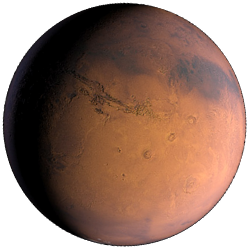
Mars is the fourth planet from the Sun and the seventh largest. Mars is named for the Roman god of War. Son of Jupiter, in love with Venus and March is named for him. Here are some of the red planet's more impressive features:
- Olympus Mons: The tallest mountain in our Solar System rising 24km (78,000ft.) from the surface. It is more than 500 km in diameter at its base and the rim of the crater is 6km (20,000ft) high.
- Tharsis: This large hill is 10 km (6 miles) high and 4000km (2400 miles) across.
- Valles Marineris: The "Grand Canyon" of Mars is 4000km long and anywhere from 2km to 7km deep.
- Hellas Planitia: There is also an impact crater over 6km (3.5 miles) deep and 2000km (1200 miles) in diameter in the Southern Hemisphere.
Mars was discovered so long ago that we don't have a record of it. Almost every culture has ancient beliefs on the red roaming star. Since it is the planet most similar to earth it has been a favorite of Science Fiction writers as the new Earth alternative. Even non Earth lifeforms are generally referred to as Martians.
Mariner 4 (US) was the first spacecraft to visit Mars with a flyby beginning July 4,1965. We have since sent a fleet of spacecraft. Mars 2 (USSR) was the first spacecraft to crash land on Mars (1971). Mariner 9 (US) was the first to orbit Mars (1971). Mars Pathfinder (US) was the first rover to sucessfully operate on Mars (1997). Mars is also known as the killer of probes. Out of the 42 missions sent to Mars so far, only 19 are considered to be a success.

Mars is much smaller than Earth. It's half the size, 1/10 the mass, 1/4 the surface area and 1/6 the volume. It has the most extreme surface features in the solar system. Mars has a significantly elliptical orbit which causes a 30°C variation in temperature from one orbital extreme to the other.
| Distance from Sun: | |
|---|---|
| Mean: | 1.52 AU |
| Perihelion: | 206,620,000 km |
| Ahelion: | 249,230,000 km |
| Size: | |
| Volume: | 1.6318 x 10¹¹ km3 |
| Diameter: | 6,794 km |
| Mass: | 6.4219 x 10²³ kg |
| Motion: | |
| Year: | 687 E Days |
| Day: | 24.6 E Hours |
| Other: | |
| Density: | 3933 kg per m3 |
| Surface Temperature: | -63°C or ~210°K |
| Gravity: | 3.69 m/s2 |
| Escape Velocity: | 5.03 km/s |
The Northern Hemisphere is covered in a lot of lava flows that that makes the surface newer than the Southern Hemisphere which is covered in ancient impact craters. There is a clear boundary between the northern and southern sections that changes in elevation by several kilometers. This extreme planetary feature has been assumed to be caused by the impact of a pluto sized body (see blue on top of map right).

We do not know exactly what the inside of Mars is like, but we do know what's on the surface, what its neighbors are like as well as the approximate size and density of the planet. Using this information we can make some general assumptions about the interior of Mars. The dense core is probably about 3400 km in diameter. Around that there is a molten rocky mantle that is a more dense than the Earth's mantle. On the surface there is a thin crust. Mars Global Surveyor's data shows that the crust is about 80 km thick in the southern hemisphere and about 35 km thick in the northern hemisphere. Mars is not as dense as the other rocky inner planets.This probably means that its core would have more sulfur than Earth, Venus or Mercury.
The core of Mars does not spin like Earth's and thus does not produce a global magnetic field. This lack of magnetic field means the atmosphere was not protected from the Solar Wind and was probably a major contributor to the lack of atmosphere today.
Mars' atmosphere is very thin and composed mostly of carbon dioxide (95.3%) plus nitrogen (2.7%), argon (1.6%) with traces of oxygen (0.15%) and water (0.03%). Since it is so thin the average air pressure on the surface is only about 7 millibars which is almost 1% of Earth. Just like on Earth it varies based on the altitude so it can be almost 9 millibars in the deep basins and about 1 millibar on top of Olympus Mons. Even though the atmosphere is thin it can sustain very strong winds which will sometimes whip up dust storms that will engulf the entire planet for months. Because of the high percentage of carbon dioxide the atmosphere produces a greenhouse effect and it raises the surface temperature by about 5 degrees (C).
Moons
Mars has two very small moons that orbit close to the planet. These were probably captured rocks from the nearby asteroid belt.
| Name | Distance | Radius | Mass |
|---|---|---|---|
| Phobos | 9,000 km | 11 km | 10.80 x 10¹⁵ kg |
| Deimos | 23,000 km | 6 km | 1.80 x 10¹⁵ kg |
More to come...eventually.
Gallery
Mars is one of the most photographed bodies in our solar system. We probably have more detailed images of Mars than the Moon. As a result we cannot publish a tenth of what's available. What we have here will give you a good idea of what the planet looks like.
Legend: Viking 1: US Lander, MGS: Mars Global Surveyor Orbiter, MRO: Mars Reconnaissance Orbiter, Mars Express: European Space Agency Orbiter, Pathfinder: US Lander, Opportunity: MER Lander, Spirit: MER Lander.
 Viking 1 - Mars 1
 Viking/MGS - Face Comparison
 Hubble - Dust Storm
 Mars/Earth Comparison
 MGS - Dust Storms
 MGS - Mars 1
 MGS - Mars 2
 MGS - North Pole
 MRO - Arabia Terra Heart
 MRO - Deimos
 MRO - Ice Channels
 MRO - Noachis Terra Dunes
 MRO - Noctis Labrynthus
 MRO - North Pole Layered Ice
 MRO - Opportunity's Path Around Victoria's Crater
 MRO - Phobos 1
 MRO - Phobos 2
 MRO - Polar Dunes 1
 MRO - Polar Dunes 2
 MRO - Proctor Crater Dunes
MRO - South Pole CO2 Ice
 MRO - Topographical Map
 MRO - Underground Ice
 MRO - Victoria Crater
 MRO - Water Evidence 1
 MRO - Water Evidence 2
 MRO - Water Evidence 3
 MRO - Water Evidence 4
 Mars Express - North Pole
 Mars Express - Phobos
 Mars Express - Phobos & Deimos
 Opportunity - Cape St. Vincent
 Opportunity - Panorama
 Opportunity - Duck Bay
 Opportunity - Dunes
 Opportunity - Heat Shield
 Opportunity - Marquette Island Sample
 Opportunity - Meteorite 1
 Opportunity - Meteorite 2
 Opportunity - Panorama Cape Verde
 Pathfinder - Panorama
 Pathfinder - Sunset
 Spirit - Meteorite
 Spirit - Panorama 1
 Spirit - Panorama 2
 Spirit - Panorama 3
 Spirit - Phobos Stacked