Quick Nav
 Venus
Venus
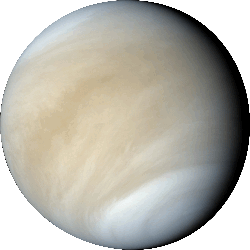
It has been said that Women are from this brilliant planet. It shines brighter than all the stars and planets. Venus gets its name from Venus, the Roman goddess of love. Here are some cool facts about this lovely planet:
- The hottest surface of any body in the Solar System, hot enough to melt Tin, Zinc and Lead.
- The planet is completly covered in clouds
- The days go backward and are eight months long.
- Most of the surface features on Venus are named for female figures.
| Distance from Sun: | |
|---|---|
| Aphelion: | 108,942,109 km (0.728 AU) |
| Perehelion: | 107,476,259 km (0.718 AU) |
| Size: | |
| Volume: | 9.38x10¹¹ km3 |
| Diameter: | 12,103.6 km |
| Mass: | 4.869x1024 kg |
| Motion: | |
| Year: | 224.7 E Days |
| Day: | 243 E Days |
| Other: | |
| Gravity: | 0.9 of Earth's |
| Temperature: | -460°C |
The pressure of Venus' atmosphere at the surface is 90 atmospheres (about the same as the pressure at a depth of 1 km in Earth's oceans). It is composed mostly of carbon dioxide. There are several layers of clouds many kilometers thick composed of sulfuric acid. These clouds completely obscure our view of the surface. The dense atmosphere produces a inescapable greenhouse effect that raises Venus' surface temperature by about 400 degrees to over 740K. Venus' surface is actually hotter than Venus's even though it's twice as far from the Sun.
Missions to Venus
Venus has had a small fleet of spacecraft visit it. Here is a list of successful probes:
| # | Name | Launch Date | Closest Approach | Mission End Date |
|---|---|---|---|---|
| 1 | Mariner 2 | 09/27/1962 | 12/14/1962 | 01/03/1963 |
| 2 | Venera 4 | 06/12/1967 | 10/18/1967 | 10/18/1967 |
| 3 | Mariner 5 | 06/14/1967 | 10/19/1967 | 11/05/1968 |
| 4 | Venera 5 | 01/05/1969 | 05/16/1969 | 05/16/1969 |
| 5 | Venera 6 | 01/10/1969 | 05/17/1969 | 05/17/1969 |
| 6 | Venera 7 | 08/17/1970 | 12/15/1970 | 12/16/1970 |
| 7 | Venera 8 | 03/27/1972 | 07/22/1972 | 07/22/1972 |
| 8 | Mariner 10 | 11/03/1973 | 02/05/1974 | 03/16/1975 |
| 9 | Venera 9 | 06/08/1975 | 10/22/1975 | 12/25/1975 |
| 10 | Venera 10 | 06/14/1975 | 10/25/1975 | ? |
| 11 | Pioneer Venus 1 |
05/20/1978 | 12/04/1978 | 08/1992 |
| 12 | Pioneer Venus 2 | 08/08/1978 | 12/09/1978 | 12/09/1978 |
| 13 | Venera 11 | 09/09/1978 | 12/25/1978 | 12/25/1978 |
| 14 | Venera 12 | 09/14/1978 | 12/21/1978 | 12/21/1978 |
| 15 | Venera 13 | 10/30/1981 | 03/01/1982 | 03/01/1982 |
| 16 | Venera 14 | 11/04/1981 | 03/05/1982 | 03/05/1982 |
| 17 | Venera 15 | 06/02/1983 | 10/10/1983 | 07/1984 |
| 18 | Venera 16 | 06/07/1983 | 10/14/1983 | 07/1984 |
| 19 | Vega 1 | 12/15/1984 | 06/11/1985 | 01/30/1987 |
| 20 | Vega 2 | 12/21/1984 | 06/15/1985 | 03/24/1987 |
| 21 | Galileo | 10/18/1989 | 02/10/1990 | 09/21/2003 |
| 22 | Magellan | 05/04/1989 | 08/10/1990 | 10/12/1994 |
| 23 | Cassini/Huygens | 10/15/1997 | 04/26/1998 06/24/1999 |
Active |
| 24 | Venus Express | 11/09/2005 | 04/11/2006 | Active |
| 25 | Messenger | 08/03/2004 | 10/24/2006 06/05/2007 |
Active |
Venus Gallery
Venus is our closest neighbor, but it's covered in clouds and it's very difficult to get pictures. Here's some anyway.
 Venus 1
 Venus 2
 Venus 3
 Venus Radar Map 1
 Venus Radar Map 2
 Venus Radar Map 3
 Venus Radar Map 4
 Venus Radar Map 5
 Venus Topographical Map 1
 Venus Topographical Map 2
 Venus Topographical Map 3
 Venus Topographical Map 4
 Venus Venera 9
 Venus Venera 10
 Venus Venera 13Venus Venera 13
 Venus Venera 13 Camera 1
 Venus Venera 13 Camera 2
 Venus Venera 13 Composite
 Venus Venera 14 Camera 1
 Venus Venera 14 Camera 2
 Venus Venera 14 Composite
Notes on Gallery
Surface of Venus - Venera 13 & 14 Composites - Don P. Mitchell using a composite imaging technique created the non distorted images of the surface of venus using pictures taken from Venera 13 & 14 missions.